Wednesday, October 9, 2013

Colorwork Meditation #10

Bermuda 2007
“I’m intrigued that one can recognize different parts of the world solely by the particular color of the water.”
                                      ~ Leonard Mizerek, American Painter


Previous Colorwork Meditation: #9 (Palette)

Saturday, October 5, 2013

What I Can No Longer Say


I cannot say that I never win anything.

If you are a blogger, and you read other blogs, you may have participated in blog giveaways at some time or another.  Like me, you may have done so for approximately 200 times.  And, like me, you may not have won a single thing.  Except that (for the first time ever) I did just win something.  Something special.

If you knit, and are online enough to be here with me now, you probably know about, and have admired, all of the stunning patterns offered at the TWIST Collective website.  They put out an online magazine four times a year and the Fall 2013 issue marked their fifth anniversary.  To celebrate, the TWIST Collective people hosted a month (almost 2 months) of giveaways that began with this post.

I entered in most of the giveaways.  I missed a few where you could only enter from Facebook or Twitter.  There were many, including the Skacel Giveaway, that you could enter on Ravelry.  For that one you had to write a six word "memoir".  Here is what I posted on the Ravelry thread just 11 days ago:

"Education, work, family, knitting, teaching, designing."


I honestly do not know if the winners were selected by random, or through merit.  Either way I was VERY lucky.  (There were over 230 posts to that Ravelry thread alone, not to mention however many there were at Facebook and Twitter.)  I received a Ravelry message from mokie/Cynthia telling me that I won this beautiful set of Addi-Click Natura (bamboo) inter-changable needles.  I was thrilled.  I had a lot of trouble choosing my one free TWIST pattern because I was really anxious to reply (and there really are so many good ones).  I choose Sapwood by Amy Herzog because I had just favorited it that same morning and I thought that was a good luck omen.

© Amy Herzog
   
If you would like to see all of the prizes and winner's names check out the Winner's Circle page.  I am there for giveaway #29, ckknit (my Ravelry name).  Thanks Skacel and TWIST!   

Wednesday, September 25, 2013

Midweek Meditation


“The sea does not reward those who are too anxious, too greedy, or too impatient. To dig for treasures shows not only impatience and greed, but lack of faith. Patience, patience, patience, is what the sea teaches. Patience and faith. One should lie empty, open, choiceless as a beach—waiting for a gift from the sea.”          
                                   ~  Anne Morrow Lindbergh, Gift from the Sea

Thursday, September 19, 2013

Angel Blue

A new color in the paintbox of my life is "Angel Blue".

I bought a new pair of sneakers (running shoes) last month.  I usually wear sneakers as my everyday shoes.  You might do so, as well, if you "worked out of your home", as I do.  Several years ago, I got into the habit of buying white walking-shoe type sneakers because they were comfortable and I liked how bright and clean they looked when they were new.  But my daughter (in her early 20's) called me out on this about three years ago.  She took me sneaker shopping, and I bought a silver, white and blue pair with a lot of mesh fabric and other layers of lattice-like cutout things.

A year later, I shopped on my own, and bought a somewhat similar pair.  She said that I did OK.

Then after another year (last month), I was on my own again, and I was surprised to see that most of the new sneakers are very colorful, as in neon.  Go look.  You will see what I am talking about.  At a Dick's Sporting Goods store near me all of the women's running and cross-sport shoes had way too much color for me.  In the last row there were a few pairs of those white walking-shoes.  I knew that they would be comfortable, but after my daughter's training, I thought that they looked too old for me.  I am not ready to be any older than I have to be.  I went back to the center display.  I tried on a shoe which had non-neon, softer colors, but there was  a whole lot of purple.

Someday I will talk about purple.  I am a firm believer that you cannot really have a favorite color because all colors depend on their surrounding colors... but, I do have to admit that for most of my life, if I had a least favorite color, it would be purple.

Those shoes by Brooks had some very vivid turquoise with the purple.  They were comfortable, but I did not buy them.

The next day I thought to look for the shoes, Brooks Ghost 5, online to see if they came in any other colors, and they did.  I liked the combination "Dark Denim, Angle Blue and Silver" quite I lot. I ordered them.  Here I am wearing them...


I am happy with my purchase.  I think that they look youthful enough.  I had not thought about "Angel Blue" before.  It generally means a pastel blue, but I also think it has a special brightness to it... closer to blue-green than blue-violet, but more like with a touch of turquoise or aqua...

When I was home from my final vacation of the summer, (We spent one week in August at the New Jersey shore.)  I saw more shades of angel blue around me.  On my little table near where I knit, there was this little book that I bought at a shop in Cape May.

GIFT FROM THE SEA by Anne Morrow Lindbergh

I have not read the book beyond the introduction, but I believe with all of my heart, that somewhere in there, I will find the words:  

"One cannot collect all the beautiful shells on the beach. One can collect only a few, and they are more beautiful if they are few." 

Which I quoted in a past blog post. In a neat connection... I began that last September post with, "As summer is slowly leaving us..."

Anyway, to get back on topic before I close this post, even one of the yarns I have been working with has some of that Angel Blue.

 
And once again summer is slowly leaving us...


Wednesday, September 11, 2013

Colorwork Meditation #9


    “Every so often change your palette. Introduce new colours and discard others. You will gain knowledge of colour mixing and your work will have added variety.”

                                               ~ Kenneth Denton, English Painter

Photo credit:  http://www.flickr.com/photos/ashleymayes/4609488728/


Previous Colorwork Meditation: #8 (Blue)
 

Monday, September 9, 2013

Around and About

Sunday, September 8, 2013.

Jo-Ann Fabric and Craft

Barnes & Noble

It's out there now.

Tuesday, September 3, 2013

Tartan Mitts Spark

I knit in herringbone.


And, I knit in houndstooth.


 Both are traditional weaving patterns.
(That I knitted.)
(And that other knitters had knitted before me.)

How could I not want to take that further?
I looked at tartan plaids, and I learned that there have been many attempts to replicate them in knitting.

Most of them were aimed
(more)
at
replicating the tartan plaid
 rather than
creating a workable knitting pattern.

An example:

http://www.flickr.com/photos/35213081@N04/4608519430/in/photostream/

Most
(as in this example)
also involved adding vertical rows of duplicate stitch.
I do think this looks amazing,
but,
I also thought, why not do a two color tartan plaid?
Worked in stranded colorwork?
It would be easier to knit,
 and would not involve duplicate stitches,
or intarsia.

I spent (much) time with my charting software.
I think that it took seven attempts at charting,
and almost as many swatches,
until I got to this:


This is a photo of the actual swatch that I sent to Interweave Knits for their Call for Submissions for Holiday Gifts 2013.
The yarn is
The Fibre Company Canopy Fingering 
(50% Baby Alpaca, 30% Merino, 20% Viscose Bamboo; 200 yd [183m]/50g)
  in the colorways Sarsaparrilla and Acai.

I loved these colors together and I loved the yarn.

But I am glad that the Interweave editors selected the red and black colors:


© Interweave Knits/Harper Point

The yarn is
Brown Sheep Nature Spun Fingering
(100% Wool; 310 yd [283m]/50g)
 in the colorways Bougainvillea and Storm.
The pattern, my own,

For even more colorwork examples of knitted checks, plaids, and other patterns see the
"Workaday Color" story, pages 106-122, of
 

Tuesday, August 27, 2013

Tartan Mitts

© Interweave Knits/Harper Point

"A bright pop of red brings Scottish chic to any wardrobe. The Tartan Mitts feature an off-center two-color plaid in identical right and left mates."

I love that "bright pop of red" thing.  I do not know who wrote that bit about my new design in a print magazine, but I do love it.

It certainly is about time that I announce my latest design... Tartan Mitts.


© Interweave Knits/Harper Point

The mitts are featured on page 113 of Interweave Knits Holiday Gifts 2013, and the pattern appears on pages 120 & 122.


© Interweave Knits/Harper Point

This magazine is available digitally at the link above.  It is currently showing up at select LYS's, and within a week should be on newsstands everywhere.

As this is only my third time to be published in print, I am very happy and very proud!


Sunday, August 18, 2013

Two-Handed Stranded Colorwork Tutorial

I have taught more classes on "Two-Handed Stranded Colorwork" than on any other kind of knitting.  As I mentioned in my preface post, most stranded colorwork (also referred to by some as "Fair Isle") involves working rows with two, and no more than two, colors at a time.  The non-active color is carried along behind the work until it is used again.

It is quite possible to knit a stranded colorwork project using only the one hand that you normally use to carry your knitting yarn -- you would have to drop one color and pick up the other each time the color changes.  After a while, you might come up with a way to hold both yarns in the same hand (I did this when I was young knitter), but it does get complicated when there are long stretches of one of the colors, and you have to drop both yarns to wrap one around the other.  It is very easy to have your yarns get tangled together.

This is why most stranded colorwork knitters eventually learn a two handed approach.

PART 1 -- YOU ALREADY KNOW ONE OF THESE TWO THINGS VERY WELL.


Holding the light and dark colored yarns with my right and left hands, allows me to knit the light color stitches with my right hand (using what is called the English method).


And knit the dark colored stitches with my left hand (which is called the continental method).


One of these methods is actually the way that you normally knit now.  The other is one that you may need to practice a bit.  I recommend that you work a swatch knitting with the opposite hand from that which you normally use, and then use both hands together for a fairly simple colorwork pattern like the herringbone section of my Equilibrium cowl.


When knitting this herringbone pattern, the longest number of stitches in one color is three.  The unused color is carried along as a "float" behind the active knitting color.  It is fairly easy to mange these relatively short floats.

Some pointers:

1) Always carry the unused color loosely in the back.  Though it is possible after knitting to tighten an overly loose float, it is truly impossible to fix floats that are too tight.  They can cause puckering on the right side.  I pause briefly (mindlessly, and almost instinctively) after every few stitches to actually spread the most recently knit stitches out a bit on my right needle... this stretches out any floats behind them to an appropriate length.  Practice this in the beginning; and you will find that before too long, you hardly have to think about it.

2) When working two-handed stranded colorwork, try placing the ball of yarn that you are working with your right hand to your right.  And place the ball of yarn to your left that you are using with your left hand.  Surprisingly, even when you do need to use the methods that I will describe below to twist the strands together, the two yarns will never tangle.

3) Stranded colorwork is best worked in the round.

PART 2 -- TWO MORE TECHNIQUES TO LEARN AND YOU WILL HAVE MASTERED TWO-HANDED STRANDED COLORWORK. 

When you work a design where there are more than three or four stitches in one color -- where the floats would be an inch or more long -- you can use the next two techniques to "catch" or "trap" or "wrap" or "weave" your floats.  I have heard each of these terms used.  The methods themselves are fairly easy, you can learn them in no time with a bit of practice.

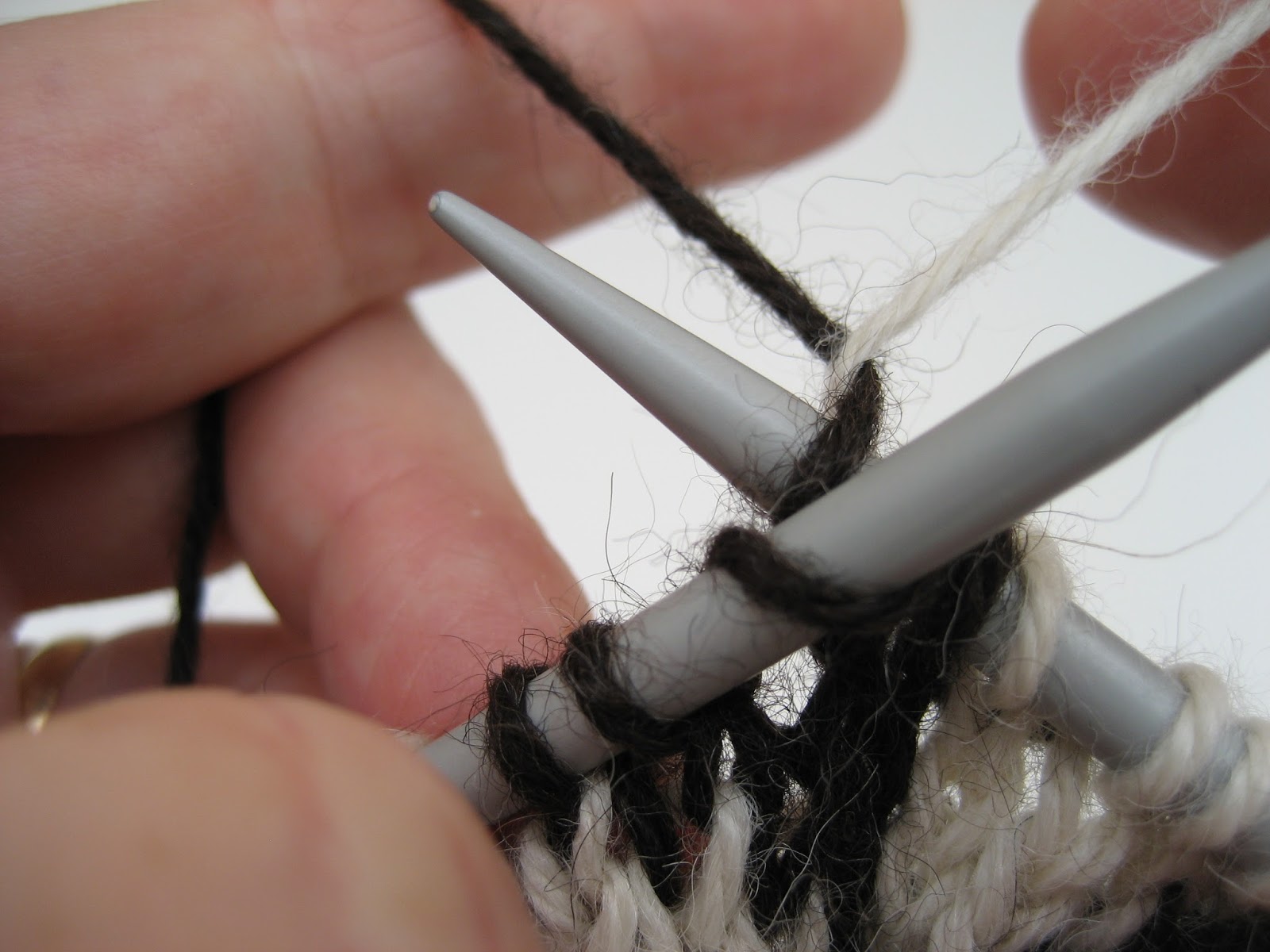
Hold the work and two strands of yarn as you practiced above.  Notice that for each of the following, the first step is always to stick the right needle tip into the stitch to be worked.

To trap the color held by the LEFT HAND when you have an inch or more of stitches in the color worked with the RIGHT HAND:

A. Stick the right needle tip into the next stitch to be worked.  Then lay the yarn being held with your left hand across the top of the right needle tip, so that it lays between the needles.


B.
Now wrap the yarn in your right hand around the right needle tip as you normally would do when knitting with your right hand.


C.  Then complete the knitted stitch.  Note: the actual "trapping" actually happens when you knit the next stitch with the right hand.


To trap the color held by the RIGHT HAND when you have an inch or more of stitches in the color worked with the LEFT HAND:

A. Stick the right needle tip into the next stitch to be worked.  Next take the color in your right hand and wrap it around the right needle tip as you would if you were to "pretend knit" with it.


B. Next wrap or "pick" the yarn in your left hand as you normally would to knit with it, but do not complete the stitch.


C. I usually call the next step "un-pretend" to knit with the color in your right hand.  Simply unwrap it from the right hand needle tip. It will go around and back.


D. Complete the knitted stitch.  Note: the actual "trapping" actually happens when you knit the next stitch with the left hand.


In the split chevron portion of my "Equilibrium" cowl, I would catch the opposite color yarn in the middle of any group of 5 or 6 stitches.


More pointers:

4)  Avoid trapping a yarn when working a stitch directly above a stitch where you trapped the same color yarn in the row below.  Trap it a stitch before or a stitch after.  (Otherwise you will get what looks like a vertical float over two rows.)

5)  Do not try to trap a color with the very last stitch knit with the other color.  You do need to work at least one more ordinary stitch to actually complete the "trapping".

Tutorials such as this one have a lot of technical details.  I hope that these techniques will help you with your stranded colorwork projects, but do give your self plenty of time to learn them.  Enjoy your colors along the way!